

The Office Furniture Buyer's Guide: What to Ask Before You Spend

Updated: Jan 22

Nobody wakes up excited to shop for office furniture.
You wake up because you need a desk. Or twelve. Maybe your home office setup is slowly destroying your back. Maybe you just signed a lease and there's 3,000 square feet of empty space staring at you.
Either way, you're here now. And the internet is full of glossy product photos, confusing size charts, and prices that range from suspiciously cheap to "is this made of gold?"
Here's what we've learned after 40+ years of helping people figure this out: the right questions save you money, time, and the particular regret of realizing your new desk doesn't fit through the door.
Before You Look at a Single Desk
What's this space actually for?
Sounds obvious. It's not.
A desk for focused solo work is different from a desk where clients sit across from you. A home office where you also fold laundry has different needs than a corner office with a view. "I need a desk" is a starting point, not a destination.
Think about:
Who uses this space? Just you? Rotating staff? Clients?
What happens here? Computer work? Paperwork? Video calls? All of it?
How long are you in this chair? Two hours? Ten?
How much space do I actually have?
Measure. Please measure. Then measure again.
The number of people who eyeball a space and end up with furniture that technically fits but makes the room feel like a submarine is... significant.
The numbers that matter:
Wall-to-wall dimensions (the obvious ones)
42" clearance behind where you'll sit (minimum for pushing back your chair)
36" for walkways (unless you enjoy squeezing)
A 9' U shape executive desk looks great in photos. In a 10x10 room, it looks like it's eating the office.
Dimensions first, decisions second. Need help? That's what we're here for.
What do I need to store?
This one sneaks up on people.
You think you're a minimalist. Then you realize you have a printer, a shredder, three monitors, a decade of client files, and that box of cables you're definitely going to organize someday.
Be honest about:
Filing needs (active files vs. archives)
Equipment that needs a home (printers, scanners, etc.)
Supplies you access daily vs. occasionally
What's currently stuffed in closets and corners
Storage isn't sexy, but understorage is chaos.

The Money Questions
What's the actual difference between new, used, and liquidated?
This is where most people get confused—and where the biggest opportunities are.
New: What you'd expect. Current production, full manufacturer warranty, longest lead times, highest price point. You're paying for being first.
Used: Previously owned, varying conditions, uncertain history. Could be great. Could be someone else's problem. Condition is everything. We offer almost new condition. No Tariffs.
Liquidated: This is the interesting one. When companies close, downsize, or relocate, their furniture has to go somewhere—often furniture that's barely been sat in. We're talking high-end pieces, sometimes months old, at significant discounts. It's not "used" in any meaningful sense. It's "almost-new."
The smart money knows: a $2,000 chair that sat in a tech company for six months before they pivoted to remote work is still a $2,000 chair.
Should I buy cheap and replace later, or invest now?
Depends on your timeline.
If this is a temporary space and you know it, don't overthink it. Get functional, get working.
If this is your office for the next five years? You're going to sit in that chair 2,000+ hours a year.
You're going to look at that desk every day. Cheap has a cost—it's just delayed.
The middle path: invest in the things that touch your body (chair, desk surface) and go practical on the things that don't (storage, accessories).
Does "Made in USA" actually matter?
For quality, it can—domestic manufacturing often means better materials and construction standards.
For your wallet right now, it might matter more than you think. Tariff situations change, but furniture crossing borders tends to cost more than it used to. American-made pieces sidestep that entirely.

The "How Do I Actually Choose" Questions
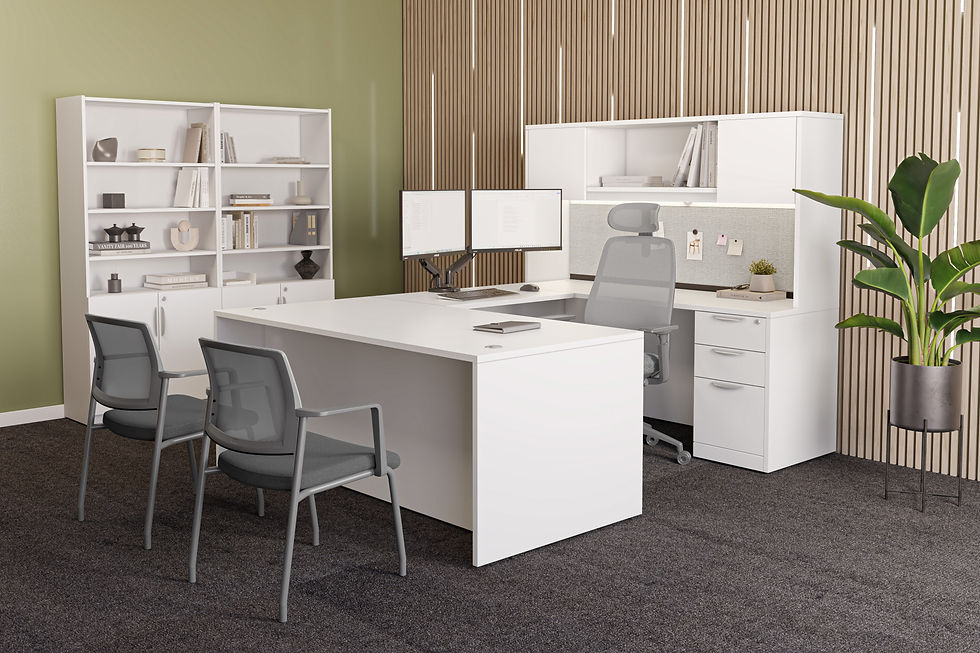
L-shape, U-shape, or straight desk—what's the difference?
Straight desk: Simple, flexible, works almost anywhere. Best for smaller spaces or if you like to keep things minimal. You can always add a return later.
L-shape: The workhorse. Gives you distinct zones—computer work on one side, paperwork or meetings on the other. Fits corners efficiently. Most people end up here.
U-shape: Maximum workspace, maximum presence. Great if you have the room and the need. Overkill if you don't. Measure twice.
There's no universally "best" shape. There's just best for your space, your work, and your budget.
How do I know if it's actually well-made?
A few things to check:
Drawer slides: Full-extension, ball-bearing slides feel solid and last. If the drawer wobbles, walk away.
Edge banding: Look at the edges of surfaces. Peeling or loose edges mean corners were cut.
Weight: Good furniture has weight. If a desk feels like you could throw it, it's not built to last.
Or: sit in it. Open the drawers. Actually use it for a minute. Your hands know quality before your brain does.
Online or showroom?
Here's the thing about office furniture: photos lie.
Not intentionally. But a photo can't tell you if that chair supports your lower back. Can't tell you if that desk surface feels cheap. Can't show you scale in any meaningful way.
Online works for reorders—when you already know exactly what you want. For first-time purchases? There's no substitute for sitting, touching, and seeing furniture in person.
Plus, showrooms have humans. Humans who've seen hundreds of offices and can tell you that yes, the 48-inch desk will fit, but you're going to hate it in six months.

The Questions Most People Forget
Who's handling delivery and setup?
A 200-pound desk in a box sounds manageable until it's in your driveway and you're googling "how to remove door hinges."
Ask:
Is delivery to the room or just to the curb?
Is assembly included?
Do they haul away packaging?
The price gap between "dropped at your door" and "fully installed in your office" is usually worth it.
What's the return policy? The warranty?
Especially online: know the policy before you buy. Returning a desk isn't like returning a shirt. Shipping costs alone can make it prohibitive.
For warranties: manufacturers usually cover defects. But "I don't like it" isn't a defect. Make sure you're seeing furniture in person or buying from somewhere with a reasonable return window.
Can I see this in different configurations?
Modular systems are everywhere now. The good ones let you start with what you need and add components later. The bad ones lock you into one configuration forever.
Ask if pieces can be reconfigured. Ask if you can add a return or hutch in six months. The flexibility might matter more than you think.
The Bottom Line
Office furniture isn't complicated. But it's also not something you want to get wrong—you're going to live with these decisions for years.
The questions above will get you 90% of the way to a good decision. The other 10%? That's where a conversation with someone who does this every day fills in the gaps.
We're not going to tell you that buying furniture is fun. But buying the right furniture, at the right price, without the runaround? That's at least satisfying.
And satisfying beats regret every time.
Jamesville Office Furniture has been helping Northern California figure out office spaces since 1993 .Our showroom is the largest in the region, stocked with new, almost-new, and liquidated furniture you can actually touch before buying.
Call : 916-638-4050 -
Email Bryan: bw@jamesvillefurniture.com
Visit Us: Jamesville Office Furniture


